

Your Professional Network Is a House of Cards: Why Connectivity Isn’t Power
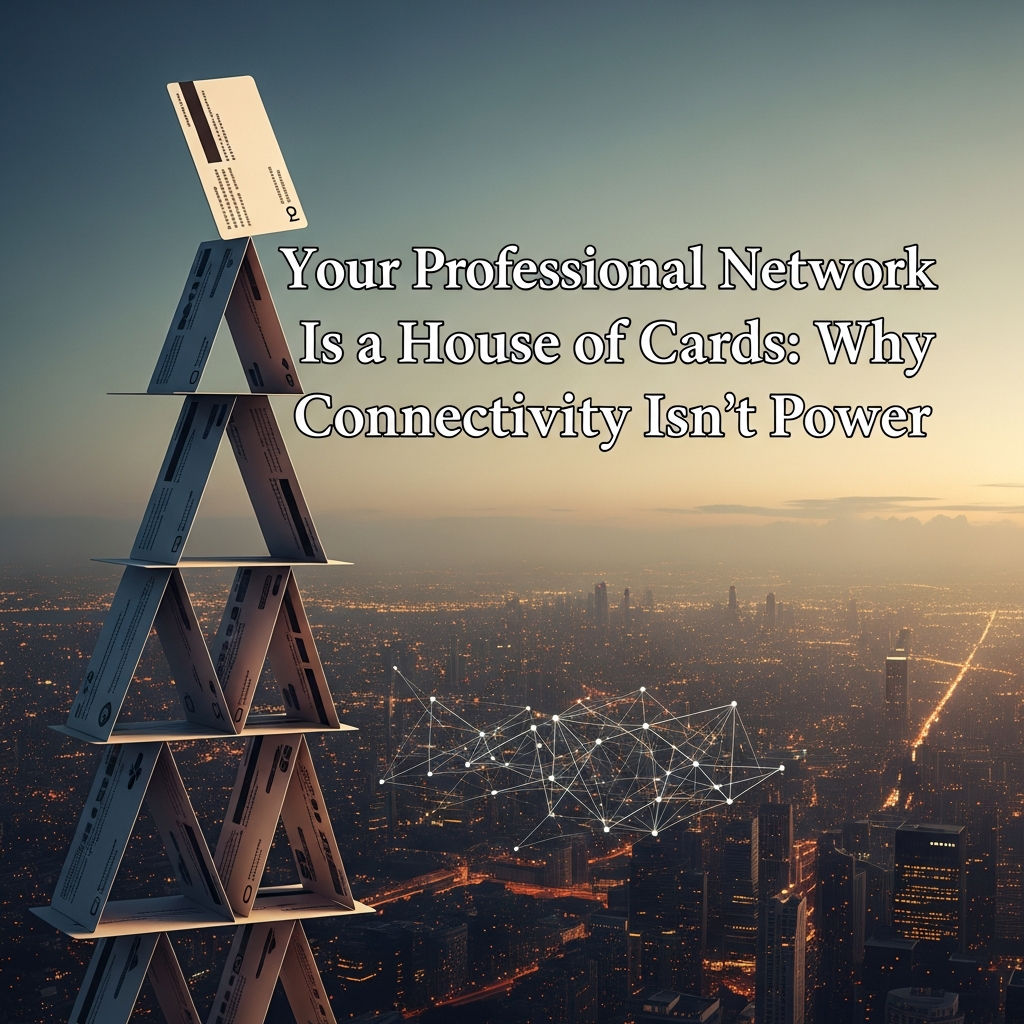
In the modern era of professional development, we have been sold a seductive lie: that the size of our digital network is directly proportional to our professional power. We hit “Connect” on LinkedIn with people we’ve never met, we collect business cards like trading cards at conferences, and we pride ourselves on a “500+” badge that suggests we are well-connected. But for the vast majority of professionals, this network is a house of cards—a fragile, hollow structure ready to collapse at the first sign of a real career crisis.
The hard truth is that connectivity is not power. Connectivity is merely the potential for communication. True power lies in the depth of relationships, the currency of trust, and the ability to mobilize resources when they are actually needed. If your network consists of thousands of strangers who wouldn’t take a five-minute phone call to help you, you don’t have a network; you have a digital rolodex of ghosts.
The Vanity Metric Trap: Why 500+ Means Nothing
Social media has gamified professional relationships. We measure our “influence” by followers, views, and connection counts. However, these are vanity metrics. They provide a dopamine hit but offer zero structural support for a long-term career. A house of cards looks impressive from a distance—it has height, complexity, and form—but it lacks the internal bonding required to withstand a breeze.
When you focus on quantity over quality, you fall into the “Vanity Metric Trap.” You spend your energy on horizontal expansion—adding more names to the list—rather than vertical deepening. In a crisis, such as a sudden layoff or a pivot into a new industry, a wide but shallow network fails. You cannot ask a stranger for a high-stakes recommendation, and a casual acquaintance isn’t going to stick their neck out to vouch for your character.
The Illusion of Reach
Many professionals believe that a large network provides “reach.” They think that if they post an update, thousands of people will see it. But algorithms prioritize meaningful engagement. If your 5,000 connections don’t actually know you, they won’t engage with your content. Your reach is effectively throttled by your own lack of depth. Connectivity without intimacy is just noise in an already crowded digital room.
Why Your Network Collapses Under Pressure
A professional network should function like a safety net or a launchpad. However, a house of cards does neither. It exists only in fair weather. There are three primary reasons why high-connectivity, low-depth networks fail when you need them most:
1. The Absence of Mutual Trust
Trust is the mortar between the bricks of a professional foundation. In a house of cards, there is no mortar. Trust is built through shared experiences, consistency, and time. If your “network” is built on a single click, there is no history of reliability. When you ask a connection for a favor, you are essentially asking them to spend their own social capital on you. Without trust, they have no incentive to take that risk.
2. The Signal-to-Noise Ratio
When you have thousands of superficial connections, your “feed” becomes a barrage of irrelevant updates. You miss the important milestones of the people who actually matter because they are buried under the weight of strangers’ promotional posts. By trying to be connected to everyone, you effectively become disconnected from the few people who could actually change the trajectory of your career.
3. The Lack of Reciprocity
A functional network is built on a cycle of value exchange. You help someone, and eventually, they help you. In a massive, thin network, the “cycle of reciprocity” is broken. You cannot possibly provide value to 2,000 people, and they cannot provide value to you. This leads to a transactional mindset where people only reach out when they want something, which is the quickest way to destroy any remaining professional goodwill.
The Difference Between Connectivity and Power
To understand why connectivity isn’t power, we have to define what professional power actually looks like. Power in a career context is the ability to get things done. It is the ability to bypass a gatekeeper, to get an honest internal perspective on a company, or to have a decision-maker listen to your pitch.
Social Capital vs. Contact Lists
Connectivity is having a contact list. Power is having social capital. Social capital is the “wealth” you have stored in your relationships. It is built through “deposits”—helping others, sharing knowledge, and being a reliable peer. When you have high social capital with 50 people, you are infinitely more powerful than someone with 5,000 connections and zero social capital. One phone call to a trusted mentor is worth more than a thousand LinkedIn “likes” from strangers.
Expertise over Exposure
A house of cards relies on appearance; a solid structure relies on integrity. In the professional world, power is often derived from being the “go-to” person for a specific problem. If your network knows exactly what you are great at, they will seek you out. If you are just a name in a sea of connections, you have exposure but no authority. Connectivity brings exposure, but only depth brings authority.
How to Build a Solid Foundation Instead of a House of Cards
If you realize your network is currently a house of cards, don’t panic. You can begin to replace the cards with bricks. It requires a shift in strategy from “collecting” to “cultivating.” Here is how to rebuild for actual power:
- The Rule of 150 (Dunbar’s Number): Research suggests humans can only maintain about 150 stable social relationships. Stop trying to manage 5,000. Identify the 100-150 people who actually matter to your industry, your growth, and your personal values.
- Audit Your Connections: Look through your network. If you haven’t spoken to someone in three years and don’t know what they actually do, they aren’t a connection; they are data. Focus your energy on the “warm” leads.
- Prioritize “High-Friction” Interaction: Digital “likes” are low-friction and low-value. A 15-minute coffee (even virtual), a personalized email, or a phone call are high-friction. They require effort, and that effort is what builds the “mortar” of trust.
- Be a Connector, Not Just a Connection: Real power comes from being the node that links two other people together. When you introduce two people in your network who can help each other, you increase your social capital with both parties simultaneously.
- Prune the Dead Wood: Don’t be afraid to disconnect or unfollow. A cluttered network obscures opportunity. By narrowing your focus, you can respond more deeply to the people who truly align with your career goals.
The Strength of Weak Ties (Revisited)
Sociologist Mark Granovetter famously wrote about the “Strength of Weak Ties,” arguing that acquaintances are often more useful than close friends for finding jobs because they provide access to new information. However, many people misinterpret this to mean that any weak tie is good. For a weak tie to work, there must still be a bridge of credibility. If the tie is so weak it’s nonexistent, there is no bridge for the information to cross.
Conclusion: Quality is the Only Sustainable Strategy
In a world obsessed with growth, the most radical and effective thing you can do for your career is to shrink your focus. A professional network built on a foundation of 50 deep, meaningful, and reciprocal relationships is a fortress. It can withstand economic downturns, industry shifts, and personal setbacks. A network of 5,000 strangers is a house of cards—it may look impressive on a profile page, but it will offer you no shelter when the wind starts to blow.
Stop counting your connections and start making them count. Real power isn’t found in how many people you can reach; it’s found in how many people are willing to reach back when you call. Connectivity is a tool, but depth is the power. Build your foundation wisely.